

Quick Answer
Solar sales commission is paid across multiple events — not in one lump sum. Most companies release 30–50% at contract signing and hold the rest until installation is complete.
The exact structure depends on the rep’s role (setter, closer, or self-gen), their worker classification (W2 or 1099), and how the company protects itself from cancellation risk.
Five commission models dominate the industry today. Each one has different payout mechanics, different administration complexity, and a different breaking point as you scale.
5 Solar Sales Commission Structures
Understanding the solar sales commission landscape starts here. These are the models residential and commercial solar companies actually use.
1. Per-Watt Commission
The most common model in residential solar.
Reps earn a flat dollar amount per watt of system capacity sold — typically $0.20 to $0.60 per watt. A 10 kW system at $0.35/watt pays the rep $3,500.
Simple to explain at onboarding. Easy for finance to model. The weakness: if the system design gets revised between contract and install, the commission amount changes — creating disputes.
2. Per-Deal Flat Fee
A fixed dollar amount per closed deal, regardless of system size.
Common in companies with standardized packages where average system size is predictable. Easier to administer but can push reps toward deal count over deal quality.
3. Revenue or Gross Profit Percentage
Reps earn 2–6% of contract value or a margin-based percentage.
This aligns rep behavior with deal profitability. The catch: it requires real-time margin visibility per deal — something most solar companies don’t have until they invest in proper reporting tools.
4. Tiered / Accelerator Plans
Rates increase at volume thresholds.
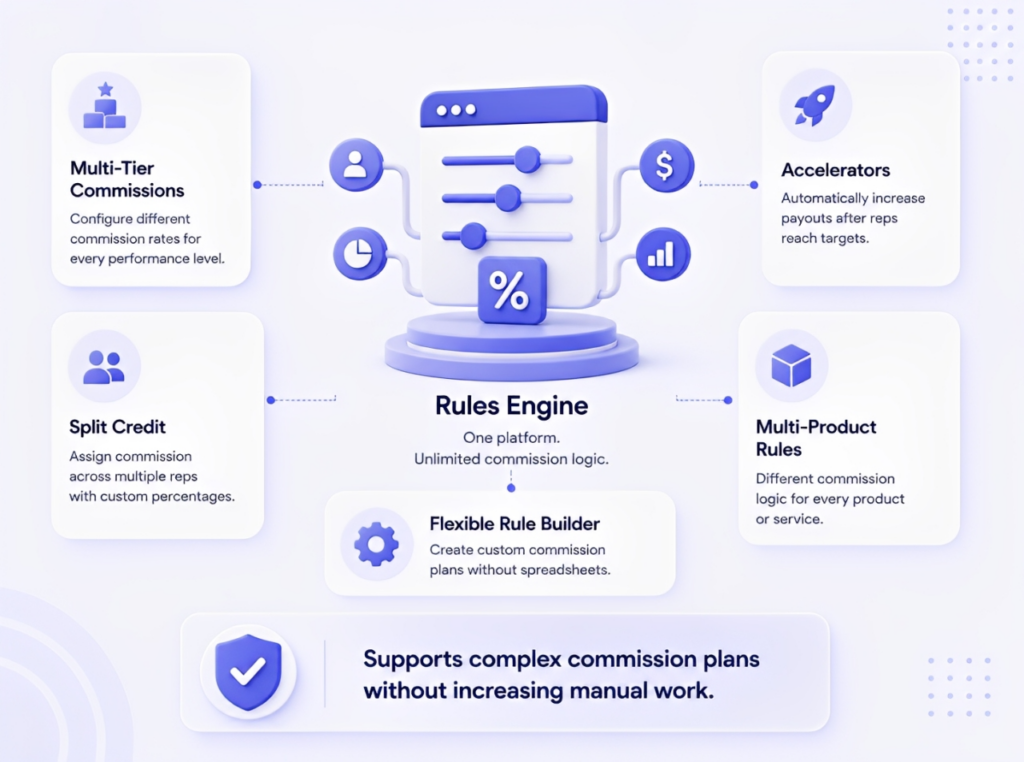
Example: $0.30/watt on the first 20 deals a month, $0.40/watt on deals 21–40, $0.50/watt above that. Accelerators drive production from top performers but make every pay cycle more complex to calculate — and faster to break in spreadsheets.
5. Setter / Closer Split
Used in D2D solar orgs that separate lead generation from closing.
The setter earns a per-deal fee ($100–$300 typically). The closer earns the primary commission. The regional manager earns an override on the team’s installs.
Three parties with a claim on every deal. This model breaks manual payout systems faster than any other.
The 3-Stage Payout Timeline
Regardless of which model you use, solar sales commission almost always follows a staged release — not a single payment at close.
Stage 1 — Contract Signed
30–50% releases immediately. Gives the rep income while the deal moves through permitting, design, and install scheduling — a window that routinely runs 4–12 weeks.
Stage 2 — Installation Complete
The remaining balance releases when the system is physically installed and signed off. This is the main clawback protection: if the customer cancels before install, only Stage 1 is at risk.
Stage 3 — Activation / NTP (optional)
Some companies add a third release tied to utility interconnection or Notice to Proceed — typically 5–15% of total. Best for orgs prioritizing long-term customer quality over install speed.
Clawbacks
A cancellation within 90–180 days post-install triggers partial or full recovery of Stage 1. Clawback rules are the #1 source of rep trust issues when applied inconsistently or explained poorly.
Why Solar Commissions Are Harder to Manage
Most industries pay commissions within days of a deal closing. Solar doesn’t.
A rep who closes in March might not receive full payment until June — after permitting, install scheduling, inspector sign-off, and utility processing. That gap creates three compounding problems.
Rep cash flow pressure.
Reps need income between Stage 1 and Stage 2. Companies that delay Stage 1 lose reps to competitors who pay faster. Pay speed is now a recruiting differentiator — see Does faster pay help recruit better sales reps?
In-flight deal complexity.
A rep with 30+ active deals has different amounts outstanding, different percentages due, and different clawback windows on every single deal. Managing that manually is a full-time job.
Override reconciliation.
Regional managers need their override amounts tied to the same install events that trigger rep payments. If install data lives in a field-ops tool and commission logic lives in a spreadsheet, someone joins them manually every pay cycle.
According to the Solar Energy Industries Association (SEIA), residential solar installations have grown substantially year over year. At that pace, manual reconciliation stops being a nuisance and starts being a growth ceiling.
What Breaks at Scale
Solar orgs that pass 50 active reps without automating their payout process hit the same failure points every time.
Formula drift. Spreadsheets absorb 12 months of one-off adjustments and undocumented exceptions. Reps on newer plans get calculated at old rates. Disputes follow.
Fragmented install data. Contract data is in the CRM. Install confirmations are in the field-ops tool. Cancellations come from customer service. Someone manually joins all three before every pay cycle.
Clawback disputes. Without a timestamped record of when each event fired, clawback enforcement becomes negotiation. Trust erodes fast.
Override miscalculations. Managers catch errors weeks after the cycle closes. Retroactive corrections create cascading adjustments — and a credibility problem.
Audit risk. State labor boards expect you to reconstruct every payout calculation on demand. Spreadsheets can’t do that.
For the broader picture, see What breaks when sales teams grow too fast?
How Sequifi Automates Solar Commission Payouts
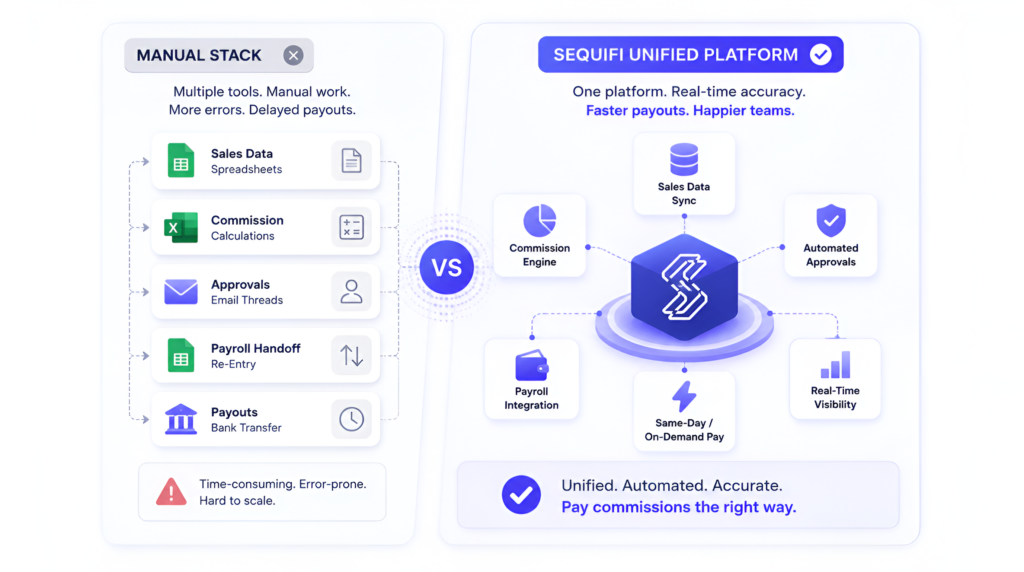
Sequifi is purpose-built for high-velocity sales orgs with complex, multi-trigger comp plans — including solar teams running setter/closer splits, tiered per-watt accelerators, and install-based payout cycles.
CRM and field-ops event data flows into Sequifi’s rules engine, which applies your comp plan logic — multi-stage triggers, clawbacks, overrides, ramps — and produces auditable payout ledgers automatically.
Those ledgers feed directly into Sequifi’s unified payroll. W2 and 1099 in the same system. No manual export between a commission tool and a payroll processor.
Learn more at sequifi.com.
Frequently Asked Questions
What is the average solar sales commission per deal?
Most residential reps earn $1,500 to $6,000 per fully installed deal. Per-watt models at $0.30–$0.50/watt on an 8–12 kW system produce this range. Strong full-time closers typically earn $80,000–$150,000+ annually.
Is solar commission paid before or after installation?
Most companies pay 30–50% at contract signing and the remainder at installation. This protects against cancellations while keeping reps paid during the permitting window.
How do solar companies handle commission clawbacks?
When a customer cancels within the clawback window (90–180 days post-install), the company recovers part or all of the Stage 1 payment. Automated systems handle this in the next pay cycle with no manual work. Spreadsheet-based systems turn it into a dispute.
How does a setter/closer commission split work in solar?
The setter earns a small per-deal fee ($100–$300). The closer earns the primary commission. The regional manager earns an override on team installs. All three amounts come from the same deal — which is why this model collapses manual payout systems first.
What software do solar companies use to manage commissions?
Most start with spreadsheets, then move to a standalone commission tool. The gap is always the same: the commission tool and payroll don’t share data. Sequifi eliminates that gap by handling both in one system.
Conclusion
Solar sales commission isn’t complicated in concept. It’s complicated in execution — especially when you’re managing 50+ reps, three payout stages, setter/closer splits, and clawback windows across hundreds of active deals.
The five models in this guide each serve a purpose. The question is whether your operations can execute whichever one you choose — accurately, at scale, without a two-day manual reconciliation every cycle.
If the answer is no, the cost compounds with every rep you add.
See how Sequifi handles any solar comp plan at sequifi.com — or book a demo to walk through your specific structure.
Related: What is the best commission structure for solar sales reps? · How do solar companies handle installs vs closed deals in pay?