
Quick Answer
Mortgage commission is most commonly calculated as a percentage of the loan amount — expressed in basis points (bps). One basis point equals 0.01% of the loan. A loan officer earning 100 bps on a $400,000 mortgage earns $4,000 per closed loan.
Most lenders combine a per-loan basis-point rate with volume tiers that increase the rate as the LO closes more loans in a month. The exact structure varies by lender size, loan type, and whether the LO is W2 or 1099.
Federal regulations also shape how mortgage companies can pay — the Dodd-Frank LO compensation rule restricts certain pay structures. This guide covers all five commission models and explains how high-volume mortgage orgs automate the calculation.
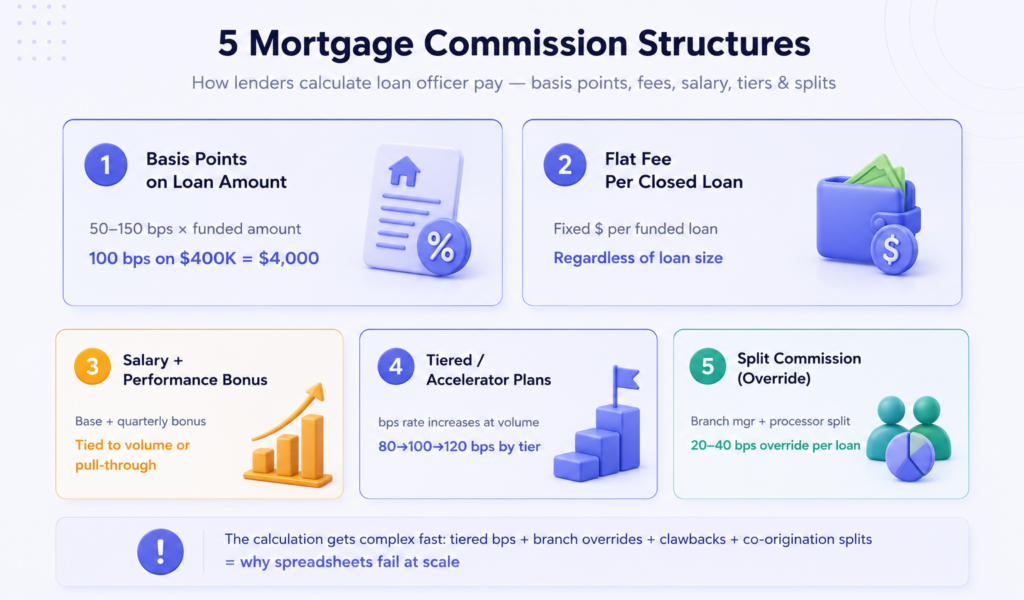
5 Mortgage Commission Structures
Understanding mortgage commission starts with the five models lenders actually use. Each has different incentives, administration demands, and compliance implications.
1. Basis Points on Loan Amount
The most common structure in residential mortgage.
LOs earn 50–150 bps on the funded loan amount. At 100 bps, a $300,000 loan pays $3,000. A $600,000 loan pays $6,000. Simple, transparent, and tied directly to volume.
The challenge: when loan sizes vary widely — as they do in jumbo and commercial portfolios — a flat bps rate can create large per-deal earnings swings that make budget forecasting difficult.
2. Flat Fee Per Closed Loan
A fixed dollar amount per funded loan regardless of size.
Common in high-volume, standardized lending operations — consumer direct shops, refinance-heavy teams, or bank branches with narrow product sets. Easier to administer but removes the incentive to close larger loans.
3. Salary + Performance Bonus
Base salary with a quarterly or annual bonus tied to funded volume, pull-through rate, or customer satisfaction scores.
Popular at retail banks and credit unions. Provides LO income stability but typically produces lower total comp than pure commission structures — which affects recruiting against independent brokers and correspondent lenders.
4. Tiered / Accelerator Plans
Basis point rate increases at volume thresholds.
Example: 80 bps on the first 8 loans per month, 100 bps on loans 9–15, 120 bps above that. Drives production from top performers but significantly increases calculation complexity — particularly in months where LOs cross thresholds mid-cycle.
5. Split Commission (Processor / Branch Manager Override)
Branch managers or team leads earn an override on their LOs’ funded loans — typically 20–40 bps on top of the LO’s rate. Senior processors or loan partners may also receive a per-loan fee from the deal.
Multiple parties with a claim on every funded loan — which is exactly where manual spreadsheet processes break first.
How Basis Points Work in Mortgage Commission
Basis points are the standard unit of mortgage commission calculation — and they’re simpler than they sound.
1 basis point = 0.01% of the loan amount.
| Loan Amount | 75 bps | 100 bps | 125 bps |
|---|---|---|---|
| $250,000 | $1,875 | $2,500 | $3,125 |
| $400,000 | $3,000 | $4,000 | $5,000 |
| $600,000 | $4,500 | $6,000 | $7,500 |
The calculation looks straightforward until you add split credits, branch overrides, processor fees, clawbacks for early payoff, and tiered rate changes mid-month. At that point, a spreadsheet stops being adequate.
The Mortgage Payout Timeline
Unlike most sales roles, mortgage commission doesn’t pay at the point of first contact or even application approval. It pays at funding — and the path from application to funding can take 30–60 days.
Stage 1 — Application / Pre-Approval No commission yet. The LO has done significant work but the loan hasn’t closed. Many lenders track “pipeline credit” internally but don’t release payment.
Stage 2 — Clear to Close (CTC) Some lenders advance a small portion at CTC as a bridge for LOs. Not standard, but increasingly common as a recruiting tool at competitive shops.
Stage 3 — Funded Full commission releases when the loan funds. This is the primary trigger for most mortgage commission structures. Funded date is the clean, unambiguous event that commission systems need to capture.
Stage 4 — Early Payoff Clawback If the borrower refinances or pays off the loan within 6–12 months, most lenders claw back some or all of the LO’s commission. Managing clawback windows accurately — across hundreds of funded loans — is where manual systems collapse.
For a full breakdown of multi-trigger payout automation, see How do companies automate commission payouts?.
Dodd-Frank & LO Compensation Rules
Mortgage commission is regulated in ways most other sales industries aren’t.
The <a href=”https://www.consumerfinance.gov/rules-policy/final-rules/loan-originator-compensation-requirements-under-truth-lending-act/” rel=”noopener noreferrer”>CFPB’s Loan Originator Compensation Rule</a> under Dodd-Frank prohibits paying LOs based on loan terms — specifically interest rate, APR, or loan-to-value ratio. You cannot pay more commission for a higher-rate loan.
Permitted pay bases include:
- Total loan amount (bps model)
- Number of loans closed
- Flat fee per transaction
- Long-term loan performance (with restrictions)
This makes compliance a live concern in commission system design. Every pay rule must be reviewed against LO comp regulations. Errors aren’t just operational — they carry regulatory risk. The <a href=”https://www.consumerfinance.gov” rel=”noopener noreferrer”>Consumer Financial Protection Bureau (CFPB)</a> actively enforces these rules.
What Breaks at Scale
Mortgage lenders that grow past 30–50 active LOs without automating their commission process hit the same failure points reliably.
Pipeline fall-through tracking. Loans die at every stage — denied, withdrawn, never locked. Manual systems don’t always zero out the commission credit for a fallen loan before the pay cycle closes. Overpayments follow.
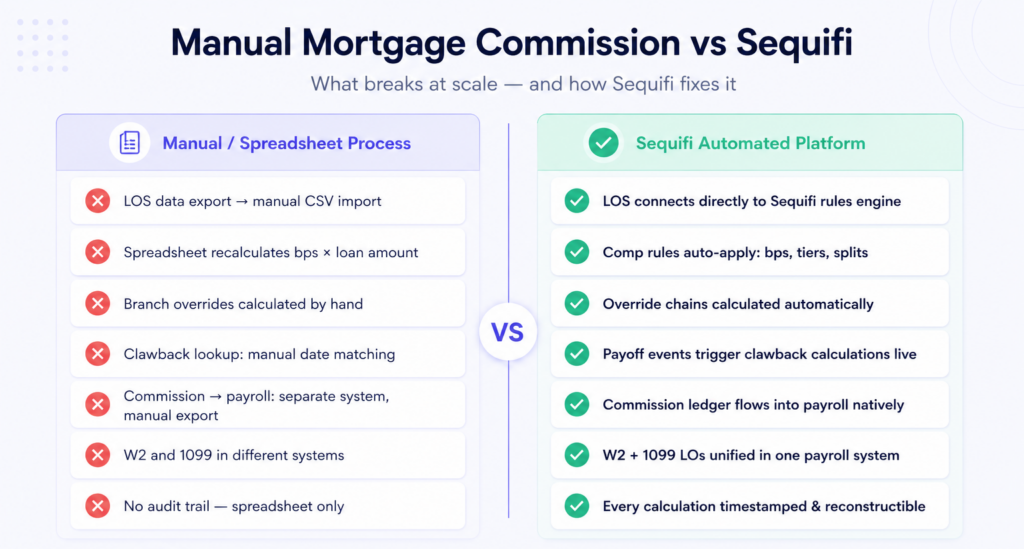
Clawback reconciliation. Early payoff clawbacks require matching funded loan dates to payoff dates months later. Manual lookup across two spreadsheets is how this usually works — and how it usually fails.
Split credit disputes. When two LOs co-originate a loan, or a referral partner has a claim, the split calculation requires explicit rules and a documented audit trail. Spreadsheets don’t do audit trails.
Compliance exposure. If your commission calculation can’t be reconstructed loan-by-loan, you have a regulatory problem, not just an ops problem.
LO churn. According to <a href=”https://www.bls.gov/ooh/business-and-financial/loan-officers.htm” rel=”noopener noreferrer”>Bureau of Labor Statistics data</a>, loan officer turnover is among the highest in financial services. Inaccurate pay is the fastest way to accelerate it. See Does faster pay help recruit better sales reps? for the broader data.
For the full picture of what growth breaks, see What breaks when sales teams grow too fast?.
How Sequifi Automates Mortgage Commission Payouts
Sequifi is built for high-velocity lending organizations with complex, multi-trigger mortgage commission plans — including shops running tiered bps models, branch manager overrides, and early payoff clawbacks.
LOS (loan origination system) data — funded loans, loan amounts, co-borrower splits, payoff notifications — flows directly into Sequifi’s rules engine. The engine applies your comp plan logic and produces auditable payout ledgers per LO per cycle.
Those ledgers feed into Sequifi’s unified payroll. W2 and 1099 LOs in the same system. No manual export. No spreadsheet. One data model from funded loan to direct deposit.
Frequently Asked Questions
How much is the average mortgage commission per loan?
Most residential LOs earn 75–125 bps on funded loan amounts. On the US median home price, that translates to roughly $2,500–$5,000 per closed loan. Top producers at high-volume shops can earn $150,000–$300,000+ annually in strong purchase markets.
Are mortgage loan officers paid W2 or 1099?
Both. Retail bank LOs are typically W2 employees. Independent mortgage brokers and many correspondent lenders operate as 1099 contractors. Some lenders run a mixed model. Managing both classifications in the same payroll system is essential to avoid withholding errors.
What is the Dodd-Frank LO compensation rule?
The CFPB’s LO compensation rule prohibits paying mortgage loan officers based on loan terms — specifically interest rate, APR, or LTV. Lenders can pay based on loan amount, number of loans, or flat fee. Violations carry significant regulatory risk.
How do mortgage companies handle early payoff clawbacks?
When a borrower refinances or pays off the loan within the lender’s clawback window (typically 6–12 months), the LO’s commission is partially or fully recovered. Automated systems match payoff events to funded loan records and adjust the LO’s next pay cycle automatically.
What software do mortgage companies use for commission calculation?
Most start with LOS-integrated reporting or spreadsheets. Larger operations move to dedicated commission tools. The persistent gap is the handoff between commission calculation and payroll — two systems that rarely share data natively. Sequifi eliminates that gap for mortgage orgs running W2 and 1099 LOs.
Conclusion
Mortgage commission calculation looks simple on the surface — basis points times loan amount — until you add volume tiers, branch overrides, co-origination splits, clawback windows, and compliance requirements.
The five structures in this guide each serve a purpose. The question is whether your operations can execute whichever one you choose — accurately, every cycle, with a full audit trail.
If your answer involves a spreadsheet, the cost of errors compounds with every LO you add.
See how Sequifi handles mortgage commission and payroll end-to-end at sequifi.com — or book a demo to walk through your specific comp structure.
Related: What is the best commission structure for mortgage loan officers? · How do mortgage companies pay loan officers faster? · How do companies automate commission payouts?