
Quick Answer: Solar sales manager commission is typically structured as an override – a per-deal or percentage-based payment on every deal their team closes. Override rates commonly run $50 to $200 per install or 5% to 15% of rep commission. Larger organizations add team performance bonuses, territory revenue share, and milestone pay. The calculation challenge is connecting team production data to the manager’s commission engine and keeping overrides accurate as reps transfer, deals cancel, and chargebacks apply.
Why Solar Manager Commission Is Structurally Different
A solar sales rep’s commission traces directly to their own deals. A solar sales manager’s commission depends on the aggregate production of 5 to 20 or more reps – each running their own pipeline, at different deal stages, with different close rates and system sizes.
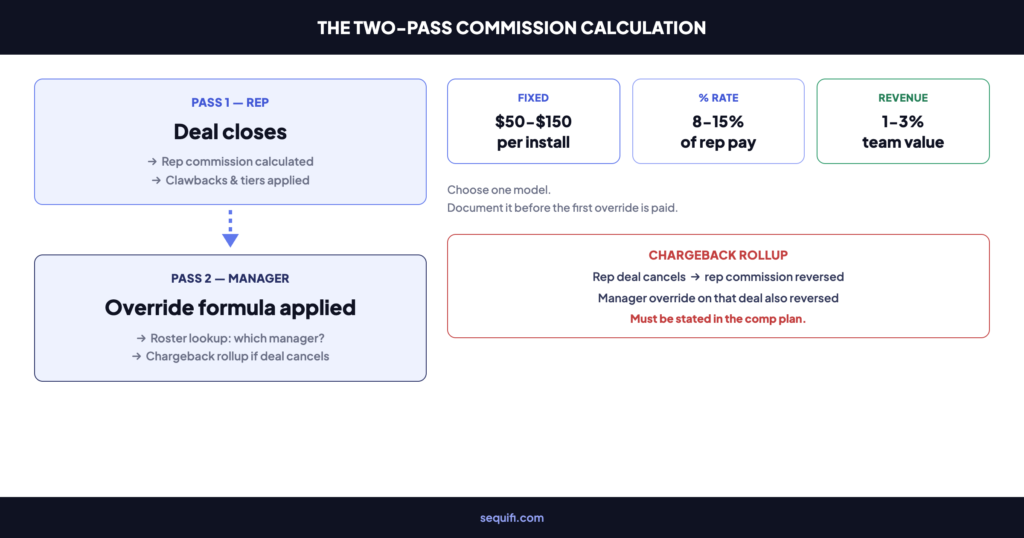
This creates a two-layer calculation: first calculate every rep’s commission for the period, then aggregate by manager, apply the override formula, and generate the manager’s payout. If any rep’s commission changes – because a deal cancelled and a chargeback applied, or because a retroactive tier recalculated – the manager’s override must also update.
Solar companies that track this manually find the solar sales manager commission calculation to be the most error-prone part of their entire pay cycle. Roster attribution, chargeback rollup, and mid-month rep transfers are all points where manual tracking consistently breaks down.
The Three Core Manager Compensation Models
Per-Rep Override
Fixed dollar amount or percentage for each deal closed by any rep on the manager’s team. Most common at mid-size solar companies. Simple and predictable.
Revenue Share
Percentage of total team contracted value or team commission earned. Ties manager pay to deal economics – better for commercial-heavy teams where size varies.
Player-Coach
Manager earns their own rep commission on personal deals plus a team override. Common in early growth phases; often phased out as team scales.
Per-Rep Override: The Most Common Model
The per-rep override is the default solar sales manager commission structure. For every deal a rep on the manager’s team closes, the manager earns an additional fixed amount or a percentage of the rep’s commission.
Fixed override per install
The manager earns $50 to $200 per residential install closed by their team, regardless of deal size or rep commission amount. Simple to calculate, easy to budget, and easy for managers to understand.
Percentage of rep commission
The manager earns 5% to 15% of whatever the rep earned on a given deal. A rep who earned $800 on an install generates $40 to $120 for the manager. This model scales automatically with deal economics – if the company uses plan-type differentiation, the manager override scales the same way without any change to the override rate.
Roster attribution: Which reps count as “the manager’s team” for override purposes must be specified in the comp plan. If a rep transfers mid-month, or a manager is promoted and inherits a team, the attribution rules determine who earns the override on deals those reps close during the transition.
Revenue Share on Team Production
A revenue share model pays the solar sales manager a percentage of total team contracted system value rather than a fixed override per deal. More common in larger organizations with commercial teams and significant deal size variation.
A manager whose team generates $800,000 in contracted value in a month at a 1.5% override rate earns $12,000 in team production commission. Revenue share creates stronger incentives to develop reps who can close larger commercial deals – the manager earns more when their team shifts to higher-value market segments without any change to the override rate.
Player-Coach: Personal Production Plus Override
In a player-coach structure, the solar sales manager earns both a rep commission on their own deals and a team override on their team’s production. A player-coach manager who closes 4 residential deals at $800 each ($3,200 personal) while their team closes 28 deals at $100 override each ($2,800 team) earns $6,000 total for the period.
The incentive conflict: Player-coach structures can create tension between personal production and team development. If a single large personal deal pays $2,000, the manager may work it themselves rather than assign it to a developing rep and earn a smaller override. Companies that want managers focused on team development often phase out personal production pay once the team reaches a defined size.
What Override Rates Actually Look Like in Solar
| Manager Type | Override Structure | Typical Range |
|---|---|---|
| Team lead (2-5 reps) | Fixed per install | $50 – $100 per install |
| Sales manager (6-15 reps) | Fixed per install | $75 – $150 per install |
| Senior manager (15+ reps) | % of rep commission | 8% – 15% |
| Regional director | % of team revenue | 1% – 3% |
| Player-coach manager | Personal commission + override | $50 – $100 override per team install |
Override rates compress as team size grows: a manager with 20 reps closing 10 installs each earns their override on 200 installs per month, so a $75 override generates $15,000 – a reasonable senior manager pay level. A team lead with 3 reps needs a higher per-install rate to earn a comparable income.
Team Performance Bonuses and Milestone Pay
Most mature solar sales manager commission structures add performance bonuses on top of the base override:
- Monthly volume bonus: Lump sum paid when the team crosses a defined install threshold in a month (e.g., $2,000 bonus at 40+ installs).
- Penetration rate bonus: Paid when the team’s close rate in a target territory crosses a defined threshold, rewarding market capture over raw volume.
- Rep development bonus: One-time payment when a rep on the manager’s team crosses a production milestone for the first time – creating direct financial incentive for coaching behavior.
Performance bonuses must specify precise trigger conditions in the comp plan: which installs count, whether chargebacks in the same period reduce the volume count, and whether the bonus is paid immediately or deferred until chargebacks clear.
The Reconciliation Problem at Scale
The core operational challenge in solar sales manager commission is reconciling rep-level events with manager-level overrides. Every time a rep’s commission changes – a chargeback applies, a retroactive tier recalculates – the manager’s override on that deal must also update.
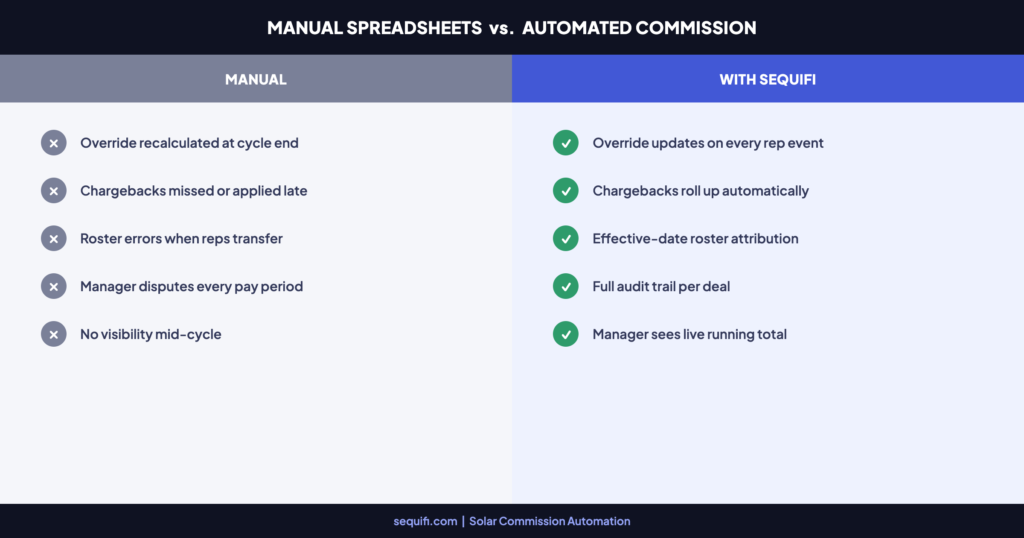
In manual spreadsheet environments, this reconciliation runs at the end of the pay cycle. It is slow, error-prone, and produces manager commission statements that cannot be traced to individual deal events. When a manager disputes their override total, the investigation becomes a line-by-line reconstruction from multiple data sources. At 50 to 200 reps across multiple manager teams, this is not feasible manually.
Compliance note: Solar sales manager commission agreements must be in writing before the compensation period begins in California (Labor Code Section 2751), New York, Illinois, and other states with written commission agreement requirements. FLSA overtime classification for sales managers must also be reviewed against actual job duties – not just title. ISO override agreements (for 1099 sales organizations) have different documentation and tax routing requirements than W2 manager pay.
How Automation Handles Solar Manager Commission
Sequifi calculates solar sales manager commission as a second-pass aggregation on top of rep-level events. Every time a rep commission event posts – install confirmed, deal funded, chargeback applied – Sequifi identifies the rep’s assigned manager for that period, looks up the override formula in the manager’s comp plan, and calculates the manager’s override in real time.
Roster attribution is handled by effective dates in the comp plan: each rep is assigned to one manager with a start date. If a rep transfers, overrides on deals before the transfer date apply to the prior manager; deals after the transfer date apply to the new manager. When a rep’s commission changes due to a retroactive tier recalculation or chargeback, Sequifi automatically recalculates the manager’s override on the affected deals and updates the manager’s running total.
The output is a complete, auditable solar sales manager commission statement per cycle – each override line traced to the rep, the deal, and the comp plan version in force when the event posted. Sequifi’s commission automation platform handles manager override, revenue share, player-coach, and performance bonus structures for solar organizations. Sequifi’s integration partners include the CRMs and proposal platforms where solar deal events originate.
Getting Started
- Choose your override model before your first manager hire. Per-install fixed, percentage of rep commission, or revenue share – each has different administrative requirements. Match the model to your current team size and complexity.
- Define roster attribution rules in writing. Which reps belong to which manager, what happens when reps transfer, and whether the manager earns on deals that close after a rep leaves their team must be specified before they become disputes.
- Specify chargeback rollup rules. When a rep’s commission is clawed back due to a cancellation, does the manager’s override on that deal also reverse? Most companies do pass chargebacks through to managers – but it must be documented.
- Write performance bonus trigger conditions precisely. “When the team hits 40 installs” must specify whether chargebacks in the same period reduce the install count and whether the bonus is paid immediately or after the chargeback window clears.
- Track override separately from personal production. If the manager is a player-coach, keep the two commission components as separate line items to evaluate whether the manager is developing their team or carrying it personally.
- Automate the reconciliation. Rep commission events and manager override calculations must be connected – not run as separate processes manually matched at the end of each cycle.

See How You Can Automate Your Solar Manager Commission
Stop reconciling rep commission spreadsheets against manager override totals at the end of every pay cycle. Sequifi runs the two-pass calculation automatically – rep commission first, manager override second – with every line auditable and traceable to the signed comp plan.See How Sequifi Works
Frequently Asked Questions
What is a typical solar sales manager commission rate?
Override rates commonly run $50 to $150 per install for fixed-per-deal structures, or 8% to 15% of rep commission for percentage-based structures. Regional directors may earn 1% to 3% of total team contracted value. The rate compresses as team size grows – a manager with 20 reps closing 10 installs each earns their override 200 times per month.
Does a solar manager earn a commission on every deal their team closes?
Yes, in most override structures – the manager earns on every deal closed by any rep attributed to their team during the period. Some structures exclude deals the manager closed personally if tracked separately under a player-coach model.
Do solar manager overrides get clawed back when a rep’s deal cancels?
In most comp plans, yes. If the manager’s override is calculated as a function of the rep’s commission, and the rep’s commission is clawed back due to a cancellation, the manager’s override on that deal reverses as well. The chargeback rollup rule must be specified in the comp plan and applied consistently.
What is a player-coach solar sales manager?
A player-coach manager earns both a rep commission on their own deals and a team override on their team’s production. Common at smaller companies or during early team growth phases. The structure can create incentive conflicts – managers may prioritize personal production over team development. Companies often phase out personal production pay as the team scales.
How do solar companies handle manager commission when a rep transfers to a different team?
The transfer effective date determines which manager earns the override. Deals that close before the transfer date are credited to the prior manager; deals after the transfer date go to the new manager. The specific rule must be specified in the comp plan to prevent attribution disputes.
Conclusion
Solar sales manager commission is the layer of pay that most solar companies get right in concept but wrong in execution. Override rates, team attribution, chargeback rollup, and performance bonus triggers are all straightforward to design – but nearly impossible to calculate accurately at scale without a commission engine that connects rep-level events directly to manager-level overrides.
The companies that get this right invest in two things: a written comp plan that specifies every rule before the first manager dispute arises, and a commission engine that runs the two-pass calculation automatically. The plan without the automation produces the right structure on paper and the wrong number on every paycheck. The automation without the plan produces fast calculations against rules nobody agreed to.
See how you can automate your solar sales manager commission at sequifi.com