
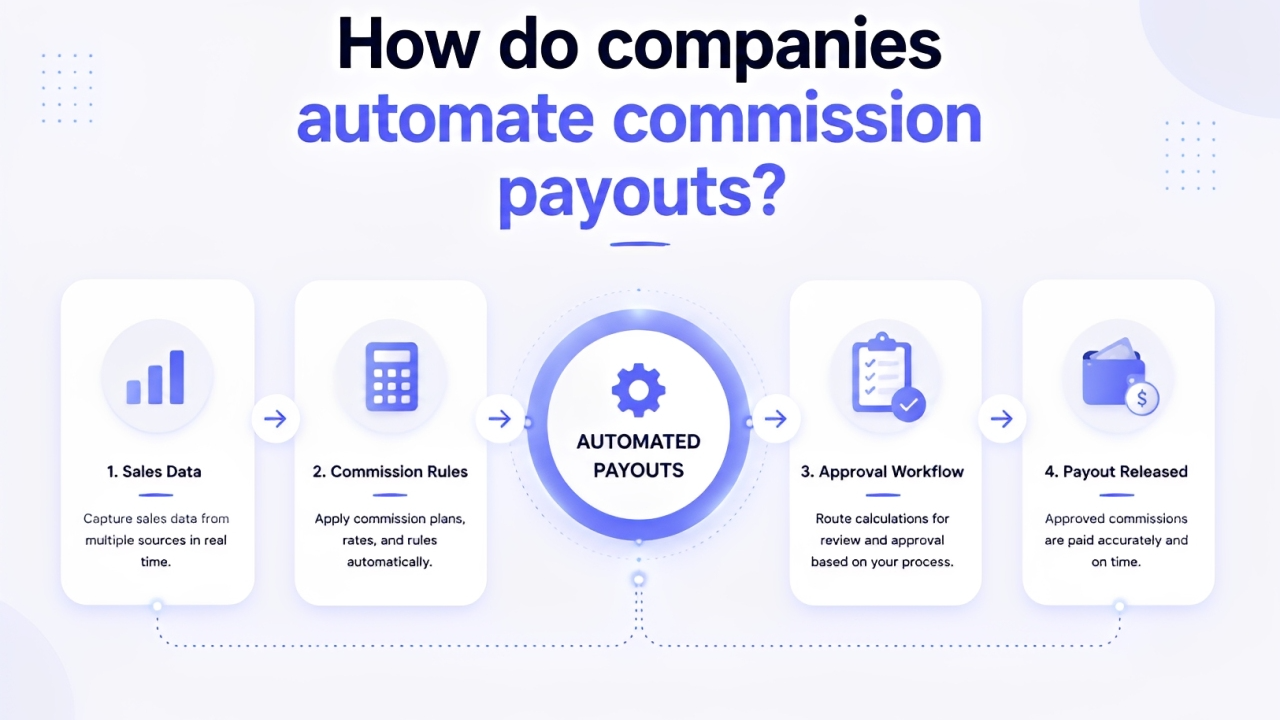
Automate commission payouts by connecting your CRM deal data to a dedicated commission engine that calculates, logs, and triggers payment automatically — with no spreadsheets, manual entry, or reconciliation steps between systems. The most effective approach links five components in sequence: a structured rules engine, a live CRM integration, automated calculation triggers, rep-facing real-time dashboards, and direct payroll disbursement. When all five are in place, reps are paid accurately every cycle with zero manual intervention from ops.
Table of Contents
Automate Commission Payouts: 5 Proven Steps
Companies that successfully automate commission payouts follow the same five-step sequence — every step is load-bearing. Skip one and you shift manual work elsewhere instead of eliminating it:
- Define comp plan rules as structured data — store triggers, thresholds, clawback windows, and override logic in a rules engine, not an Excel formula
- Connect your CRM as the deal data source — when a deal changes status, the commission engine reads it automatically; no copy-paste required
- Set calculation triggers for every payout event — deal close, install confirmation, milestone hit, and clawback all fire automatically on the right event
- Deploy rep-facing real-time dashboards — reps see their earnings update live as events occur, eliminating the information gap that causes disputes
- Integrate with payroll for automatic disbursement — the number the rep sees in their dashboard is the number that hits their bank account; no handoff gap
Each step builds on the last. Attempting to automate commission payouts without a structured rules engine means calculation still happens in a spreadsheet. Integrating payroll without rep dashboards solves the ops problem but not the trust problem.
Deep Dive
Why most teams can’t automate commission payouts cleanly
The core problem is that commission data lives across 3+ systems that don’t share a data model: CRM (deals), payroll (disbursement), and a spreadsheet in the middle (calculation). To automate commission payouts end-to-end, you need to eliminate that middle layer — not build a smarter bridge between the CRM and the spreadsheet.
Teams that attempt to automate commission payouts without removing the spreadsheet usually hit the same three failures:
- Partial automation — they automate calculation but leave data entry manual; ops still copies deal data from Salesforce into the commission tool by hand
- No audit trail — they connect CRM to payroll but skip logging; when a rep disputes their payout, there’s no timestamped record of what calculation ran on what data
- Brittle scripts — they build custom code to link systems, which breaks every time plan rules change and requires an engineer to fix
The only sustainable way to automate commission payouts is a platform where rules, data, calculation, rep visibility, and payroll disbursement all live in one system. See the most common failure points: what causes payroll errors in commission-based teams.
The rules engine and CRM integration
The first requirement to automate commission payouts reliably is a rules engine that treats comp plan logic as structured, versionable data. Each rule has an effective date range — so the system knows which plan version applies to a deal that closed in March vs. a deal that closed in June. When a deal closes in the CRM, the engine reads the deal fields, matches them to the active plan, applies thresholds and modifiers, and produces a calculated payout in milliseconds.
This approach eliminates the two most common manual steps: looking up the current plan version and entering deal data into a calculation sheet. Most orgs that try to automate commission payouts without a proper rules engine still perform both steps manually — they’ve just made the math faster, not the process. The right fix is to replace spreadsheets for commission tracking entirely, not digitize them.
Triggers, dashboards, and payroll
Real-time triggers are what separate a partial solution from one that fully automates commission payouts. A trigger fires when a specific deal event occurs — status change, install confirmed, cancellation within clawback window — and kicks off the calculation automatically. The rep’s dashboard updates immediately. The calculation is logged with a full audit trail: deal ID, rule version, input values, output, and timestamp.
Payroll integration completes the loop. A SHRM study on pay transparency found that employees who understand how their pay is calculated report significantly higher job satisfaction and lower intent to leave. Automation makes that transparency structurally possible — reps can see the math, not just the result. See how this fits into broader commission structure management.
What Breaks at Scale
At 20 reps, a diligent ops manager can run commission calculations manually each cycle. Painful, error-prone, but survivable.
At 50 reps, the inability to automate commission payouts starts showing up in turnover data. Top performers — who track their comp most carefully — notice errors first and escalate fastest. One bad cycle generates a wave of disputes that consumes the ops team for days.
At 100 reps, manual commission processing becomes a hiring bottleneck. Companies start adding ops headcount whose sole job is reconciling commission data — a cost that scales linearly with rep count. Organizations that automate commission payouts at this stage see ops time on compensation drop by 80% or more, according to Gartner’s sales performance management research. The headcount savings alone often cover the software cost within a quarter.
At 200+ reps, it’s structurally impossible to maintain accuracy without automation. The number of deal events, plan variations, clawback calculations, and rep-level exceptions exceeds what any manual process can handle reliably. Read how this connects to eliminating commission disputes at scale.
Manual commission workflow vs. fully automated system: time spent, error rate, and dispute volume at each rep count.
How Sequifi Solves This
Sequifi is built to automate commission payouts from the first deal event to the final bank transfer. Every comp plan rule is defined once in the platform — triggers, thresholds, clawback logic, override conditions — and applied automatically to every qualifying event without human intervention. No spreadsheet in the middle, no manual data entry, no reconciliation between calculation and payroll.
When you automate commission payouts with Sequifi, reps get a live earnings dashboard that updates as events occur. They see exactly which deal triggered which rule, what the gross payout was, how any adjustments were applied, and what the net total is — before the pay cycle closes, not after. If a rep has a question, the answer is already in the dashboard. Disputes drop to near zero because the math is visible and verifiable.
Sequifi handles both commission calculation and payroll execution in the same system, eliminating the handoff gap where most errors occur. For D2D, solar, fiber, and pest control teams at 50–500 reps, that means one platform that pays every rep type — W2, 1099, hybrid — accurately and on time, every cycle. See how it compares: best payroll software for D2D sales teams.
Frequently Asked Questions
How do companies automate commission payouts?
Companies automate commission payouts by replacing manual spreadsheet processes with a dedicated commission platform that integrates directly with their CRM and payroll system. The five-step approach — rules engine, CRM integration, event triggers, rep dashboards, payroll disbursement — eliminates every manual touchpoint in the commission cycle. The result is accurate, on-time pay with a full audit trail and zero ops reconciliation.
What software is needed to automate commission payouts?
To automate commission payouts effectively, you need a purpose-built commission management platform — not a generic HR tool with a commission module bolted on. Key capabilities: structured rules engine with plan versioning, bidirectional CRM integration, real-time rep dashboards, full audit trail, and native payroll integration. Sequifi is built specifically for high-velocity field sales teams with complex commission structures.
What are the benefits of automating commission payouts?
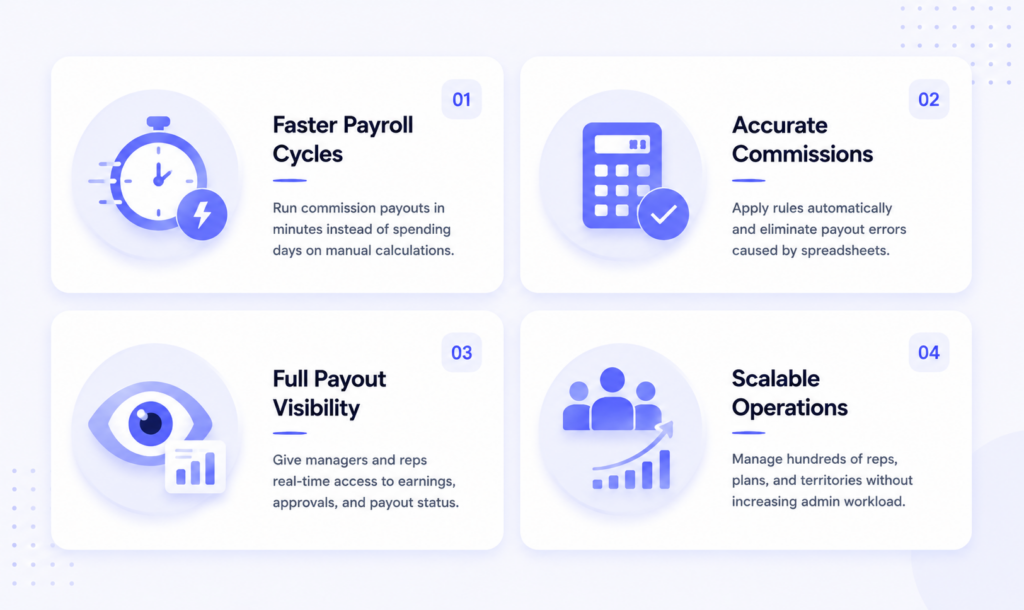
The primary benefits are accuracy, speed, and trust. Accuracy: automated systems apply plan rules consistently with no formula errors or copy-paste mistakes. Speed: reps are paid on time every cycle without ops spending days on reconciliation. Trust: real-time dashboards give reps visibility into their own earnings before payday, eliminating the information gap that causes disputes. Most orgs see dispute volume drop 80–90% after switching.
How long does it take to automate commission payouts?
Most organizations fully automate commission payouts within 3–5 weeks: 1 week to document current plan rules, 1–2 weeks to configure the platform and run a parallel pay cycle for verification, then go-live. The parallel run proves accuracy against your existing process before you’re fully committed. With a purpose-built platform and vendor support, most teams complete migration without disrupting a live pay cycle.
Automate commission payouts by building the five-component system: structured rules, CRM integration, event triggers, rep dashboards, and payroll disbursement in one platform. The manual alternative — spreadsheets, reconciliation, and month-end scrambles — costs ops time, creates disputes, and drives rep attrition that compounds every quarter you delay.
If your ops team is still calculating commissions by hand, that’s a fixable system problem.